Training
The Best Bodyweight Exercises for Glutes at Home
By the Reshape 30 Team··7 min read
The most effective no-equipment glute exercises, how to do each one with good form, and a sample 15-minute glute workout you can do at home two or three times a week.
Can you really build your glutes without weights?
Yes, especially if you are new to strength training or returning after a break. Your glutes respond to challenge, and bodyweight exercises can provide plenty of it when you use the right variations, control your tempo, and progress over time.
The key is to avoid doing endless easy reps. Once a move feels easy, make it harder: switch to a single-leg version, slow down, add a pause at the top, or increase the range of motion. These techniques make bodyweight work far more demanding than it looks.
Glute bridges and their variations
The glute bridge is the foundation of at-home glute training because it lets you load your hips without stressing your knees or lower back. Lie on your back, bend your knees, and place your feet flat about hip-width apart. Press through your heels to lift your hips, squeeze at the top, and lower slowly.
A common mistake is arching the lower back to lift higher. Instead, tuck your ribs down slightly and stop when your body forms a straight line from shoulders to knees. You should feel the work in your glutes, not your lower back or hamstrings alone.
- Pause bridge: hold the top for 3 seconds each rep
- Marching bridge: hold the top and alternate lifting one foot
- Single-leg bridge: one foot planted, the other leg extended or bent
- Elevated bridge: shoulders on a couch edge for a bigger range (hip thrust style)
Squats, split squats, and lunges
Squats work the glutes along with the thighs. To bias your glutes more, sit your hips further back, take a slightly wider stance, and go as deep as you can while keeping good form. Pause briefly at the bottom to remove momentum.
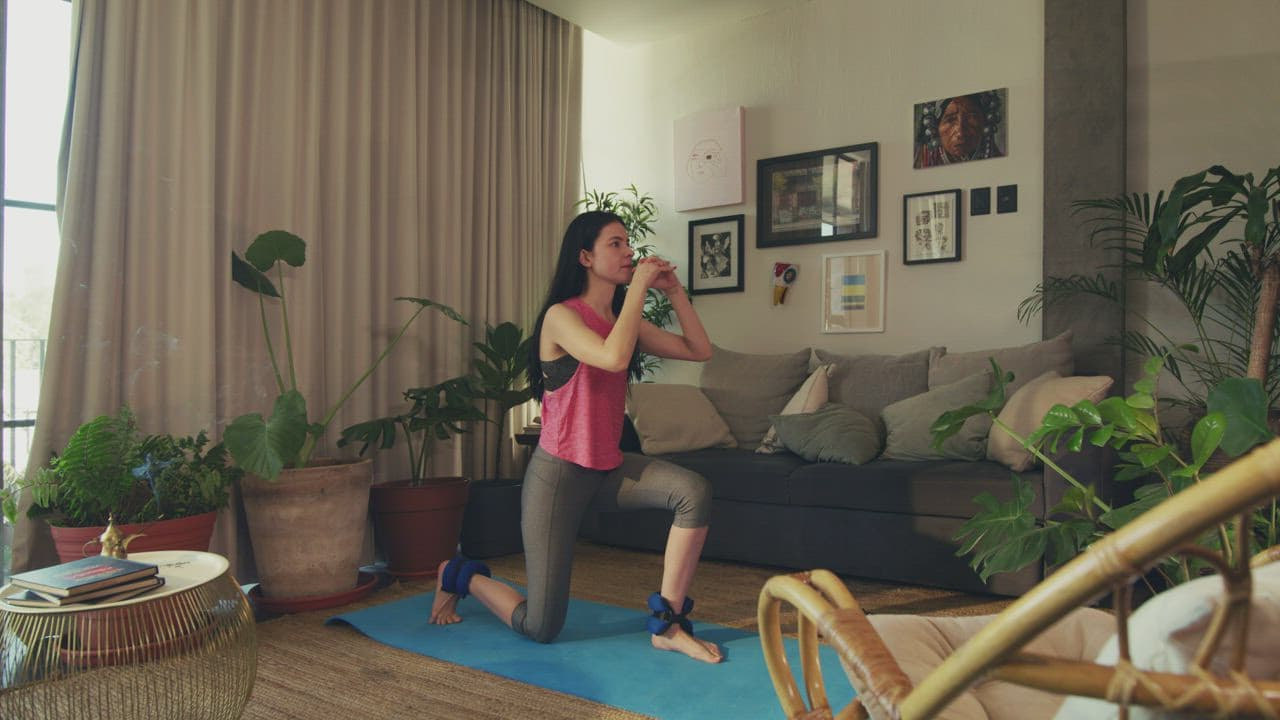
Split squats and reverse lunges are even more effective at home because they put most of your body weight on one leg. Leaning your torso slightly forward and stepping a bit longer tends to shift the work toward the glutes. Hold a wall or chair for balance; it lets you focus on the muscle rather than wobbling.
- Pulse squat or pause squat for extra time under tension
- Split squat with a 3-second lowering phase
- Reverse lunge, which is usually easier on the knees than forward lunges
- Bulgarian split squat with the back foot on a couch, as an advanced option
Hip hinges and side-body moves
The hinge pattern trains your glutes as hip extensors. Without weights, a single-leg Romanian deadlift (reaching your hands toward the floor as one leg extends behind you) is a great option. Keep your back flat and your hips square, and move slowly.
Your glutes also stabilize your hips side to side. Moves that work the upper and outer glutes help round out your training and can make other exercises feel more stable.
- Single-leg Romanian deadlift, holding a wall for balance at first
- Side-lying leg raise with toes pointed slightly down
- Clamshells with a slow squeeze at the top
- Fire hydrants and donkey kicks on hands and knees
- Curtsy lunge, if comfortable for your knees
A 15-minute at-home glute workout
Warm up for 2-3 minutes with marching, hip circles, and bodyweight good mornings. Then complete the circuit below 3 times, working for 40 seconds and resting 20 seconds between moves. For single-leg exercises, do 20 seconds per side.
Finish with a figure-four stretch and a kneeling hip flexor stretch, about 30 seconds per side. Do this workout two or three times a week on non-consecutive days, alongside upper-body and core work for balanced strength.
- Glute bridge with a 2-second squeeze
- Reverse lunge (alternating)
- Side-lying leg raise (20 seconds per side)
- Pause squat
- Single-leg Romanian deadlift (20 seconds per side)
How to keep progressing
Progress is what turns a glute routine into real results. Every week or two, change one variable: add a round, move to the single-leg version of a move, slow the lowering phase to three or four seconds, or add a pause at the hardest point.
Pair your training with enough protein and sleep, since muscles adapt during recovery, not during the workout itself. And be patient. Visible changes in shape take time and vary from person to person, but strength gains, such as easier stairs and steadier balance, often show up within a few weeks.
Not feeling it in your glutes? Try these fixes
Many women say they feel squats and lunges mostly in the front of their thighs, or bridges mostly in their lower back or hamstrings. That is common, and small adjustments usually help.
Start each session with one or two lighter activation moves, such as clamshells or a slow pause bridge, so you can practice squeezing the right muscles before the harder work. Then slow everything down. Rushing tends to let stronger muscles take over, while a controlled pace gives you time to feel the glutes doing their job.
- Bridges: move feet slightly closer or farther away until you feel the glutes most, and push through your heels
- Squats: sit back more, as if reaching for a chair behind you
- Lunges: take a longer step and lean your torso slightly forward
- All moves: pause and squeeze at the point of hardest effort
This article is for general educational purposes and isn't medical advice. Talk to your healthcare provider before starting a new exercise or nutrition program.